FREE PITCH CHECK
Play the seven D’s on your piano. Your phone measures how far each one has drifted, then tells you which tuning it needs and what it costs. It takes about a minute.
Works best on a phone, on the music stand, in a quiet room.
HOW IT WORKS
1
Set your phone on the music stand
Find a quiet moment, as to get the best pitch reading possible.
2
Play each D, left to right
Firmly, holding each key for a second or two. A dot settles above the key once it has a steady reading.
3
Get your answer
Which tuning your piano needs, the price, and a button to book it. Spotted a sticky key too? Add it in one tap.
YOUR RESULT
The check averages your seven D’s and matches it to the same three tunings on our pricing page.
Within 10¢
Standard Piano Tuning
Your piano is holding its pitch. One careful tuning brings every note back in line.
10 to 30¢
POPULAR
Pitch Raise Tuning
Two tuning passes in one visit, so the tuning holds. Typical after a couple of years without a tuning, or a move.
30¢ or more
Extreme Pitch Raise Tuning
Three careful passes to bring the string tension up safely. Typical for inherited and long-forgotten pianos.
A cent is one hundredth of a semitone, the step from one key to the next. Whatever your number, no piano shaming. Ever.
WHY IT WORKS
Why the D’s?
Every D sits between the two black keys, so anyone can find it. The seven of them run from the deepest bass to the top of the treble.
Measured the way a technician hears it
A well-tuned piano isn’t perfectly flat on a tuner app: the bass sits a little low and the treble a little high. The check measures against that stretch, so a healthy piano doesn’t read as out of tune.
Great for new-to-you pianos
Bought, inherited or moved a piano and don’t know when it was last tuned? See where it stands today and book the right service the first time.
A typical well-tuned piano
How far each of the 88 notes sits from a plain tuner app, in cents
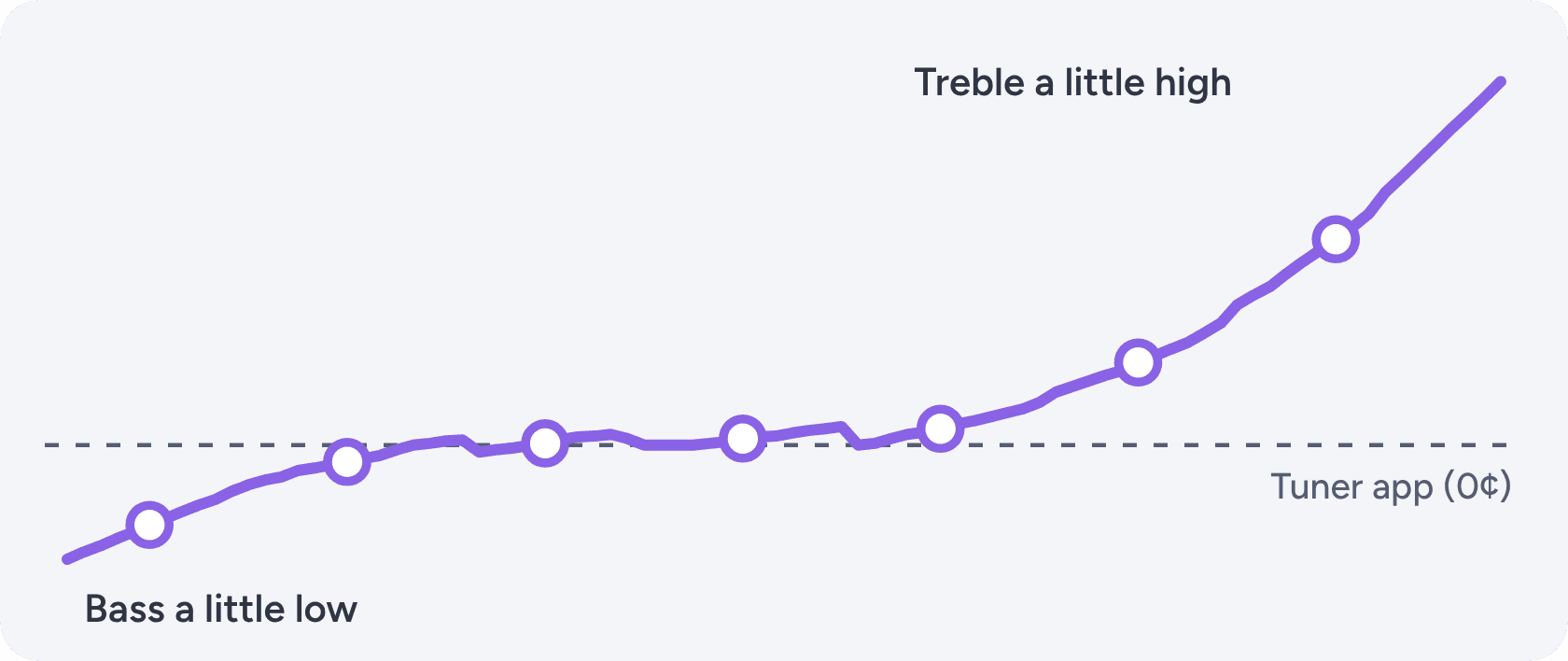
The circles are the seven D’s the check listens to.
QUESTIONS